Friday, February 29, 2008

A girl from Moyamba

Several months ago a colleague of mine told me about a case he was working on. Four years ago a 14 year old orphan girl in Moyamba district, Sierra Leone, was offered “love” by a young man. She rejected him. Later when she was going to collect palm wine, he ambushed her, attacked her with a cutlass, and raped her. As a result of her injuries, she started bleeding through her nose and nipples during menstruation. She has to be hospitalized every month, and recently has been going into a severe fit every time.

After the initial attack, the man said he’d take medical responsibility for her. No surprise he didn’t. Instead, a year ago he attacked and assaulted her again. She’s now confined to a safehouse and a hospital every month when she menstruates. He’s living in his town, out on bail.

Since I heard about this girl in Moyamba, I haven’t gone a day without thinking about her. It’s with me wherever I go.

As someone focused on human rights issues, it’s not as if I haven’t read or seen my share of horrors. And like many people here, I almost believed, in a twisted way, optimistically and naively that I couldn’t be shocked anymore. But this was new. A way of suffering I never even knew or could have imagined possible.

Dostoyevsky commented, “We talk of bestial cruelty. But that is a cruel insult to the beasts. A beast can never be so artistically cruel as a man.” We can and should admire the amazing artistry of beauty in this world, but the darkness is just as artistic, just as creative, just as inventive.

I thought then, and I think now of Ivan Karamazov querying his brother Alyosha in the smoky tavern. He tells Alyosha about a “poor child of five.”

"(She) was subjected to every possible torture by those cultivated parents. They beat her, thrashed her, kicked her for no reason till her body was one bruise. Then, they went to greater refinements of cruelty- shut her up all night in the cold and frost in a privy, and because she didn't ask to be taken up at night (as though a child of five sleeping its angelic, sound sleep could be trained to wake and ask), they smeared her face and filled her mouth with excrement, and it was her mother, her mother did this. And that mother could sleep, hearing the poor child's groans! Can you understand why a little creature, who can't even understand what's done to her, should beat her little aching heart with her tiny fist in the dark and the cold, and weep her meek unresentful tears to dear, kind God to protect her?"

And he asks Alyosha, if Alyosha could create a world to guarantee man’s future happiness, where he could transform all suffering into joy and comfort, but only on the condition that “it was essential and inevitable to torture to death only one tiny creature - that baby beating its breast with its fist, for instance - and to found that edifice on its unavenged tears, would you consent to be the architect on those conditions?”

When Dostoyevsky left the Siberia prison camp where he was exiled for six years, he commented, “If someone proved to me that Christ is outside the truth and that in reality the truth were outside of Christ, then I should prefer to remain with Christ rather than with the truth.” Like Kierkegaard, the despair of a godless world, where “everything would be permitted,” terrified him too much. So even if it meant rejecting truth, they decided to take the leap of faith, accept Pascal’s wager, and simply embrace god as a divine placebo to the hopelessness they saw facing them otherwise. There would be none of Feuerbach’s ability to find hope in the rejection of god and embrace of “the anthropological essence of religion” - god as merely a projection of man. Nor would they be able to find comfort in the Nietzschean “will to power” after the declaration of the death of god. Rather faith in god grew partially from the fertile soil of fear, fear that if they “gazed into the abyss the abyss would gaze also into them,” fear that a life without god could only be sustained by Schopenhauer’s irrational “will to live,” fear that the world may really be as dark as it often appears, and only some otherworldly power and faith could salvage the wreck.

But I’m not concerned with whether god exists or not. Stuck with my Euclidean mind, it’s an answer beyond my ability to discern. Perhaps I prefer to take the folk singer Iris Dement’s refrain and “let the mystery be,” or bear homage to Kierkegaard’s concession that he is too stupid to understand philosophy, and philosophy is too clever to understand his stupidity. I just can’t help but wonder: Dostoyevsky argued that without god, all things are permitted. But if god does exist, if god can and does act in this world, and if a girl will bleed every month through her nose and nipples, what things aren’t permitted, even with god?

My question is then like Ivan’s. If you could create an architecture guaranteeing man’s future happiness, divine justice, the conversion of all pain to joy, but one girl must be raped and have to bleed every month through her nose and nipples… would you consent? And perhaps more importantly, could you praise such an architect?

Wednesday, February 20, 2008

On the road to freetown...

On Tuesday, I made my way back from Kabala in the Koinadugu District of Sierra Leone. We rolled down the windows of the 4WD, offering some relief from the heat by letting the dry, dusty, hot air rush into the car. As we pulled into Makeni for a brief stop to buy some vegetables, a woman came over. Her right arm was marred by severe burns from her hand to shoulder. The scars covered her flesh like a thick bacteria slowly crawling its way up and around her body. Her left hand was even worse. A mangled mess, her fingers wrapped around themselves and splayed off in different directions. You could only imagine what caused the injuries. Perhaps in the war she was caught in a Revolutionary United Front (RUF) attack; or perhaps the Civil Defence Force (CDF) or Kamajors suspected her of RUF complicity; or perhaps it was just a cooking or work accident. There are so many potential sources of pain and injury. It need not be as "glamorous" as civil war, genocide, slaughter, or torture. Torture comes in too many forms to narrow it down in such a way...

The woman approached our car, and shoved her disfigured hand in through the window into our faces, asking for money. Like anyone else, we recoiled, said no, and rolled up our windows. We finished our shopping and continued on our way back to Freetown.

I suppose I should try to say something profound now. But these things happen all the time here.

---

For reasons I may explain later, I came back from Kabala with a new sense of purpose in the choices I have made. Or at least I tell myself. I've always been good with words, laying out philosophy and principles with rhetorical and poetic flourish, but words without actions are dead, as James 2:20 reflected about faith. There's no need to write about all the new things I've learned or decided. If I really learned them, the only words that matter will be carried out through my actions, in the kingdom of the here-and-now, and anyone with eyes to see will be able to judge what really lies in my heart and in my head. For now, I depart with just one last reflection.

While climbing one of the many hills in Kabala, I thought about the great commission - the moment in the Christian story when Jesus tells the disciples to go out into the world and spread his word. Jack Miles argued in God: A Biography how, in the Jewish canon, God had been moved to silence after his argument with Job, how God never spoke again but became the silent, reclusive, tired Ancient of Days described in Daniel. What if the central narrative of the Bible is less about how God acts in the world, but how He's decided not to? Maybe the Great Commission is also a hand-off of responsibility to us, to take on the burden of the world and heal it, to become "world saviors," as the Gnostics would put it? Christian or not, maybe there will be great strength and power and compassion and love available to us if we seek it ("seek and you shall find") - whether from man's natural goodness, his ability to reason, or from the "divine spark" in each of our hearts, or whatever term of art we may use - but perhaps, at the end of the day, the only God to help us is the God within us. The responsibility is ours. And it's terrible and terrifying, and liberating...

We need not fly to Sierra Leone to find injustice and suffering. It can be found anywhere - in our cities, in our towns, in our neighborhoods, and in our day-to-day relationships, and it's just as real there as anywhere else. For human rights doesn't begin in some remote corner of the Congo, or some impoverished slum in Freetown. It begins at home - with how we treat everyone we profess to hold dear in our heart. If we can't do even that right... how can we ever talk about human rights and respect for man?

Tuesday, February 5, 2008

Saving the world

The last village we visited today was Serabu in Kenema District of Sierra Leone. Our CLTS team, Kamboi, was already there implementing the strategy. While walking towards the meeting area, Kamal Kar - the pioneer of CLTS - noticed a young boy lying on the steps of a building. He asked the surrounding members of the community about the kid. The kid was clearly severely dehydrated in the dry, dusty 40 degree heat; his frail arms seeming as if they would break when we touched them. We got a water bottle from our vehicle, and gave him some salt and sugar water to rehydrate him. Our Ministry of Health and Sanitation (MoHS) escort took him to the local health center. As the kid began to vomit, the nurse reported that the village had a very high rate of diarrhea and dehydration but most didn’t come to the health center because of a local witch doctor.

While all this happened, our team worked diligently to carry out our strategy to get the community to clean up the village, unaware of the tragedy slowly unfolding steps away. How easy it is to become so focused on saving the world that you lose sight of saving one person.


(Children in the village of Serabu after they wrote and sang a song telling their community to clean up the village so they don't get sick and die)


(Children continuing through the village singing)

Saturday, February 2, 2008

The many faces of Sierra Leone

I just spent a week working on a Community Led Total Sanitation project. I head up to Kenema for a week tomorrow to continue the project. During this week, I caught a glimpse of the many faces of Sierra Leone.


Saturday, January 26, 2008

A kid and an orange

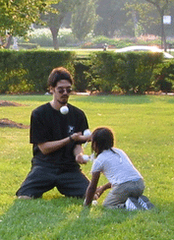
A kid offered to buy me an orange today. I met him at Lumley beach as I was juggling with some other kids. He was with a group of friends of his, who were pushing him around in a wheelchair. When he came over to watch me, he crawled out of the wheelchair and slowly pulled himself across the sand - his right arm and leg inverted, twisting around themselves like a poorly formed vine. We tossed the ball back and forth, with him throwing the ball into various juggling patterns. He explained how he was living on the street around the bus station along Wallace Johnson street; he no longer had any family because most had been killed in the war or died of diseases. Beyond his fellow street kids, wheeling him around in his chair, he had no one. And then he offered to buy me an orange because he had some money.

When I was in Mali, as a UN employee, I “earned” DSA (Daily Subsistence Allowance) for resting. I earned more money by taking a vacation than these children may make in a lifetime; I earned more money for one day of “rest and recuperation” than families here make in a year. I came here to fight against injustice; sometimes I wonder if I’m part of the source of it. We talk of income inequality back in America, but we have no idea of what it looks like. The UN perpetuates one of the most glaring systems of income inequalities in the world, and I am the beneficiary. And while we maintain our positions of wealth, a poor street kid offered to buy me an orange.

In Mali, I thought a lot about one of Thomas Aquinas’s arguments, and as the children stripped off their old and ragged clothes and headed to play in the ocean, I thought of it again. Aquinas, in contrast to Nozick or Rand, argued that right to property or ownership was based less on possession than need. That a rich person may possess great wealth but that person had less right to that wealth, that food, that life-saving bread than a poor person, a poor and hungry child. He argued that in a sense, it was the wealthy that were stealing from the poor simply by not sharing the possessions they had. I have no interest now in parsing the philosophical merit of this argument, or dissecting the practical policy or economic implications of following the logical conclusion of this argument through to the end. Only sitting in the hot sun on Lumley beach, the sky filled with the harmattan haze, the children frolicking naked in the waves, a poor street child pulling his inverted and twisted body over the sand, I couldn’t help but feel there was at least a seed of truth to Aquinas’s claim.

After spending a few hours with them, I ended up doing what everyone else does, and what you‘re forced to do a hundred times in a country like Sierra Leone. I walked away, heading out into the long stretching beach before me - this slice of paradise, and turned my back to the least of these.

Thursday, January 24, 2008

Reflections from the past

I was just reading some entries from a brief blog I kept in Princeton. I put them up now because the sentiment still resonates with me, and I wrote it better then than I could do now.

(journal)

5/9/04

at the end of the day, i want justice; i want be the voice of the voiceless; i want to do what's right

at the end of the day, i want to be happy

i wonder sometimes if those things are incompatible....

1/20/04, 10:01

sometimes i think that the hardest thing about believing in humanity's potential is being constantly reminded how far short we fall of it.... perhaps, an idealist isn't someone who believes in an ideal world, but someone who refuses to lower his values, refuses to abandon the ideal even when it's betrayed by those around him...

there are 70,000 child soldiers in burma

last year, 10,000 children were abducted and forced to become soldiers in the Joseph Kony's Lord's Resistance Army

in 1994, we watched genocide unfold in rwanda, and witnessed the fall of Srebrenica

11/30/03, 4:27 pm

my dad brought me "the watchmen" on friday, and i reread most of it again last night. there's something about that story that always gets to me. i have often wanted to walk from this path that i have chosen, longing for some easier road, to be able to close my eyes to the world's dark underbelly. but i can't. and even if i could, i would never choose to do it. once a man has faced the truth in all its forms, he can never turn back.... sometimes i ask myself why i fight for the rights of strangers. watching mehdi zana speak about his eleven years in torture, knowing that his wife was probably going through something similar; i was able to formulate what i had been feeling and thinking for so long.

if someone i loved was suffering or being tortured, i would want some random stranger to do something, anything to try to make a difference. how can i ask anything less of myself? i am that random stranger to so many people.

11/29/03

1:27pm

i suppose i feel talkative today. sitting alone in the basement of a deserted robertson hall. i just reflected on jacob landau's eerie pictures about man's inhumanity to man. maybe i shall go looking for beauty later today...


11:25 am

beauty is present in the simplest of things


"in the depth of winter, i finally learned that within me there lay an invincible summer." - albert camus

11/12/03, 3:29 am

it's another all-nighter in Friend. the issue of human rights in liberia lies before me. i wonder sometimes why i pour over these human rights document, learning the stories of unnamed women being gang-raped, left in some abandoned village, bleeding from their vaginas. or of child soldiers pumped with "bubbles" to make them brave and strong as they can engage in some horrible, random atrocity. or of soldiers dressed in wedding dresses and flowing colorful wigs, amputating and collecting limbs to acquire some reward from their commanders. what is it that makes us stare into the heart of darkness? what is it that allows us to still survive despite the horror? is it simply schopenhauer's irrational, all-pervasive, irresistable "will to live," a wild dionysian ethic pulsing through our veins, a Karamazov thirst for life? how can we stare at beauty after seeing such horrors? doesn't the contrast with the beauty make the horror too terrible to bear? but how can we help but stare at beauty after living in such darkness? needing something to cleanse our souls of the terrible filth of reality? how can we maintain faith in humanity seeing it so degraded? how can we lose hope when we see the good that people can do? "Bad is so bad that we cannot but think good an accident; good is so good that we feel certain that evil could be explained."

it's so late that's early.... i've been staring in the shadows for so long, sometimes i wonder how my eyes will adjust when they see light again. but i want to face these demons, i want to believe the world is beautiful despite everything; i want to be able to proclaim the beauty of world, not out of ignorance or fear of facing reality, but because i have seen it in all its heart-rending horror and all its breath-taking wonder.

it's late. and i need to focus my mind on negotiating some path through problems of terror in some far off land..... i've been thinking of this quote from The Thin Red Line recently: "what difference do you think one man can make in all this madness?" i don't know. but i want to find out.

About me:
In High school and at Princeton, one could easily chalk my career as a success with a solid academic record and impressive extracurricular resume. Like most students, I could list my accomplishments as I have done and fool myself into thinking that they really mean something important, but I don't think that they do. My success is not defined by those things. My focus throughout high school and Princeton has not been acquiring awards or recognition. Despite the due care that I put in all my works, laboring over every word in a paper, obsessing over each nuance of the guitar string, or learning the precise angle for a drop shot, it is life that I have tried to invest the most care into. My final work, my final project is simply the life I live.

When Buddha was asked who he was, they said: "Are you a God?" He said, "No." "Are you an angel?" "No," he replied again. "But then what are you?" He said simply, "I am awake." I have often longed to wake up, to see the world with an un-obscured vision, to slice through all the distractions of existence and to begin to truly see the form and logic pervading all things. I do not believe that humans are destined for intellectual or moral slumber. I do not believe that we are unable to move the world and move ourselves. We are so busy making excuses for our failures; we are so willing to abnegate our responsibility, to relinquish our ability to change ourselves. We often forget that life is an art; we must take due care to live properly and study the precepts for living a good life.

For the past several years, I have studied human rights violations, pouring over heart-rending accounts of slaughter and destruction.

Why? Because if any of my friends were being beaten or raped or tortured, I would have a problem with someone standing by and doing nothing about it. If this is true, then seeing the immensity of evil in this world; I cannot with clear conscience stand by with utter indifference in the face of such abject suffering.

Why? Because when I say that the world is beautiful, I do not wish to say it because I am ignorant and unable to face the darkest corners of reality.

Why? Because if we wish to know truth, then we cannot pick which truth we wish to see, for there is only one truth, one reality, one world, and it is simply up to us whether we wish to face it or run away to cower in fear of a reality we are unable to face.

Tuesday, January 9, 2007

What we will become tomorrow

This is my first post, so I suppose I should explain two things: first, the title of the blog and, second, why I'm blogging at all. I took this title from something Paul Rusesabagina said, "With my countrymen -- Rwandans -- you never know what they will become tomorrow." And in his country, it was true. In a 100 days, in the summer of 1994, around one million Tutsis and Hutu moderates were slaughtered mostly with machetes and gardening tools. The perpetrators were mostly "regular" people asked to kill, to do their "work" in eliminating the Tutsi cockroaches. Much has been written about why this took place in this tiny country in the Great Lakes region of Africa, pointing to colonialism, illiteracy, overpopulation, and any assortment of explanatory factors. Others have written extensively on the culture of obedience in Rwanda, most notable in the fetid squalor of the overflowing prison cells. In 1995, as many as nine prisoners were dying per day from diseases, all awaiting a trial that promised to be years in the coming - if at all. Bill Berkeley visited one of them, writing:

"My guide through the Kibungo prison was the elected leader of the prisoners, a thirty-eight-year-old former businessman named Joas Kaburame, himself accused of genocide... I asked Kaburame what seemed to me an obvious question: Was there ever any violence in this awful place?
'There are no fights,' he replied matter-of-factly, without a trace of irony, 'It's forbidden to fight. They must respect the rules.'
"This was the culture of obedience, chillingly illuminated, at the very heart of Rwanda's darkness: three thousand accused mass murderers packed in horrendous conditions like snakes in a bottle - and no violence."

All this is not to propose some answer to the question of Rwanda, but that the question exists in the first place. What would Rwandans become tomorrow? It wasn't written in stone. Some of the perpetrators would reply simply, "I was told to kill, so I killed. They don't tell me to kill, so I don't kill. If they asked me to kill again, I would kill again." Yet saying that it isn't written in stone is, in an odd way, as Philip Gourevitch noted, the most optimistic thing you could say about Rwanda. It meant there was hope.

And in the end, it's one of the most important questions we can ask of ourselves. We can't change our past, and obsessing over it is often a sure way to repeat it (certain that our past inevitably lays out a roadmap for our future, we ensure that it does). What we can do, and all we can do, is focus on the here-and-now, and build towards the tomorrow. We don't know what we will become tomorrow, which means we can become better, which means life is an open page and we can try to write what we will on it, which means we carry in ourselves a terrible and terrifying responsibility to live life artfully and well - or we and others will suffer the consequences of our negligence.

The second question, of why I'm blogging, is perhaps harder to answer. Most of the reasons people give for doing anything are vastly different than the actuals reason for doing anything. We put a nice, rational public face on our actions, as explanations for our deeds and misdeeds, but they rarely explain our actual motivations, which exist in the bizarre, almost indecipherable, world of our emotions and personal history, a world of magic and wonder, fear and terror, signs and symbols, of mystery. So almost any answer I give now will probably be at most partially true, and only partially honest. I'm blogging because I want to write fairly regularly again, about ideas and thoughts, philosophy and religion, and this seemed a forum to motivate myself to do it. But in reality, I'm probably blogging because I should be heading to Madras right now, and in some bizarre chain of connections, this seemed the proper response to not being there. And that's a puzzle I'm not sure I will ever fully be able to decipher.

Best,
Darren