A few hours ago, I was sitting near the spot of Jesus' ascension on Mount Olive. The sky had just unleashed a torrent of rain, and the dark and foreboding clouds were still rolling over the hills and valleys of the Jerusalem. A few rays of light pierced the clouds, falling on the shimmering golden facade of the Dome of the Rock. Before me lay all of the Old City of Jerusalem, its massive walls, the imposing Temple Mount, and the sweeping hills soaked with history and memories and war and suffering and hope. And I felt so far from the tiny town that I came from.
Tuesday, November 25, 2014
On giving thanks
A few hours ago, I was sitting near the spot of Jesus' ascension on Mount Olive. The sky had just unleashed a torrent of rain, and the dark and foreboding clouds were still rolling over the hills and valleys of the Jerusalem. A few rays of light pierced the clouds, falling on the shimmering golden facade of the Dome of the Rock. Before me lay all of the Old City of Jerusalem, its massive walls, the imposing Temple Mount, and the sweeping hills soaked with history and memories and war and suffering and hope. And I felt so far from the tiny town that I came from.
Wednesday, October 1, 2014
Victoria
----------------------------------------------------------------------------------
Post-script: If you want more information about human trafficking, you can check out my article on domestic sex trafficking, Finding Safe Harbor, which was recently cited by U.S. House Judiciary Committee. The National Human Trafficking Hotline is also a great resource if you think you've witnessed human trafficking or want more information.
Tuesday, March 8, 2011
Ghosts
I’ve been thinking of her face a lot recently.
Long black flowing hair. Deep, dark, penetrating eyes. Soft, warm hands part clenching, part caressing mine.
And it’s possible she was begging me to rape her.
Late at night along Khao San road - that famous backpackers’ haunt in Bangkok - as the parties begin to wind down, the prostitutes without a client for the night become more desperate. They follow you and beg. They grab your hands with both of theirs. Stare deep into your eyes, the desperation etched onto their young, beautiful faces – carrying echoes of pain far beyond their years.
I don’t know if she was a trafficking victim. I don’t know if beyond the façade of consent there was a story of brutality and violence and psychological manipulation, or whether it was just the daily bite of poverty. But I know for many of the girls, the daily rapes are preferred to returning to the pimp or mama-san without filling their quota, and so they hold your hands in theirs, and stare deep into your eyes and beg to be violated.
Behind each story of horror is a panoply of characters. The pimps lurking in the corner, negotiating the price, and arranging the meet-up. The girls often offered promises of love and comfort. As one ex-prostitute said, the pimps know to target the girls who “just want to be loved.” And then there are the clients, the Johns. Outsourcing violence to the pimps so they can carry out rape without being a rapist, so they can live out every fantasy and desire, while maintaining a mask of innocence, hidden behind a façade of consent, perhaps even charity for the impoverished girls they exploit.
I could’ve told this story not of Thailand but of almost any city or town in the U.S. The average age of entry into prostitution in the U.S. is 12 to 14. There are over 2,500 prostituted minors in NYC. They are over 100,000 prostituted minors in the US. They work on street corners. They’re advertised online and in newspapers. They’re sold by parents and friends and lovers and strangers. They’re sold in small residential towns and in fancy escort services. And they’re all hidden in plain sight. Impossible to find. Yet found constantly by Johns eager to find some soft, warm flesh. As International Justice Mission’s president, Gary Haugen, reflected: "It's the easiest kind of crime in the world to spot. Men look for it all day, every day."
Some girls are sold 40 times a night. The DOJ worked a case where a girl was sold 68 times in one night. You begin to do the math. 40 rapes a night. 5-6 nights a week. 200-240. For a month. 6000-7200. For a year. And the horror can seem almost too much to be true.
People sometimes ask me how I do this work. Frankly, I don’t know how you couldn’t. You stare into the eyes of someone stripped of their humanity and sold as meat, you see children dancing half-naked on stage to satiate the appetites of Western and local sex tourists. You meet a slave. How can you live with yourself if you don’t try to do something about it?
Today, March 8, is International Women’s Day. In Vanderbilt Hall, a coalition of NYU law school student groups will be fundraising for GEMS, and showing “Very Young Girls,” a documentary about prostitution of minors in NYC, about sex trafficking in NYC. It’s an important reminder of the horror and pain all around us, and the real people caught up in it. And it’s even more important to remember, to learn about the people fighting against it – person by person.
Sunday, January 9, 2011
Banos to Puyo 2 - drenched...
After finishing the trail, my main bike ride began. I switched on some Rammstein and Pantera for the energy in the challenging uphill ride ahead, my leg still hurting from yesterdays accident. About an hour into the trail, it started raining. I kept going. In a few hours, I found a place to eat in the tiny town of Rio Negro. The sun had broken the rain for a bit, and it seemed like it was clearing up. I forgot that I was leaving the highlands and heading towards the rainforest. After Rio Negro, it started raining... harder, and then pouring. For the next two hours, rains slashed down the trail and road reducing visibility. I took shelter under trees for a bit before realizing it wasnt really helping, and just plowed through, climbing hills and racing down mountains, the lush countryside obscured by thick fog. Finally, the rain broke and made it the last 12 kms to Puyo, dripping with rain and sweat.
The trail was done, and as for me, I feel like another adventure... after a nap.
Saturday, January 8, 2011
Banos to Puyo 1 - What a day...
The day started out early. I got up around 7 am to start hiking and headed to the trail to Bellavista Mirador, up one of the mountains overlooking the tourist trap of Banos (but jumping off point for some off-trial adventures). At the overlook, you see an incredible view of Banos, sheltered by lush green hills and a snow-capped volcano in the distance. I continued up the trail to the small village of Runtun. On the way down, there was several large groups of school children heading up for a special English class. A few of the teachers stopped to ask me directions, laughing that they were asking directions from the sunburnt gringo on the trail. The long lines of kids would have give me high fives (or rather low-fives since they were so short) as they passed me. There were also several groups of stragglers, kids around 9 or 10, lagging behind on the long, hot trek up the mountain. They also stopped to ask me how to the get to the school, and for a few precious moments, we chatted in Spanish about their English class and I gave them directions up the trail. It was probably the first and only time I will ever be asked for directions from Ecuadorians, in Ecuador.
I made my way down the rest of the trail to the Virgin Mary overlook, and then returned to Banos to prep for my bike trip. I grabbed a quick lunch of cuy or guinea pig from a local stall. Stacks of the guinea pigs lay on the grill, including several on sticks. It never ceases to amaze me how, even in a tourist trap like Banos, you can quickly leave the beaten path and find local stores and vendors, which offer more authentic experience for less money (and with better food).
Finally, I was ready to set off on the Banos to Puyo bike trail. It would take too long to describe everything on the trail, but here are a few highlights.
At Mano de Novia, a gorgeous double waterfall, I took a small, rickety cable car to the top of the waterfalls and a small village. They had a tiny fishing pond, and two local women caught one of the fish for my second lunch. I took it to go, and then hiked down to the bottom of the waterfall, eating my food as the power of the falls sprayed water in my direction.
Continuing the trial, I found another waterfall, name El Placer, which is rarely visited by tourists. I went off wandering the back trails, locals pointed me to a path to the cascade, and I found a spot halfway down, water streaming down both sides of me, and the water plunging over the precipice just a few steps from where I sat.
The next major waterfall was Pailon del Diabolo. After a long hike down, you climb through a narrow cave system to get right below the waterfall, its raw power drenching you with the cold, refreshing water. After that, you can continue the hike to a small rickety bridge giving you a clear view of both levels of the falls.
At this time it was getting rather late, so I needed to hike back up and look for a place to sleep in Rio Verde, a small town surrounded by lush green hills and a roaring river. I asked around for a hostel, and locals only mentioned one to me, which I visited but was overpriced. I knew there were supposed to be other hostels further down the road, so I decided to set off and see if I could find them. In my haste, I got distracted waving to a couple kids, crashed my bike and skinned one of the my knees. Now limping and bruised, I continued biking the next 2.5 kms up the hill only to find both hostels closed. One of the owners mentioned that he thought there might be two hostels in Rio Verde (I had only seen one).
I headed back as light was beginning to fade. I asked again about a hostel, and the locals I talked to pointed me to the same one. I began wandering around town, and noticed a building that looked kinda like a hostel but without a sign. There was a man washing his car in front of the building and I asked him about it. Turns out he was just working on building a new hostel, and he had one room that was sort of ready. He showed me the room, dirty floor, mattress without sheets, windows covered with construction plastic. They quickly cleaned the room and gave me some 101 dalmatians bedsheets. It was perfect.
And so my day ended, 25 kms on bike, 10 kms on foot, 4 waterfalls, bruised, bleeding and exhausted, I would sleep in a barely constructed hostel in Rio Verde.
Thursday, January 6, 2011
Pigs
I had a quick breakfast at one of the vendors - cows, sheep, and llamas streaming by as I ate, and one of the vendors protested when a cow took a dump in front of her stall and the new owner just continued on by (someone came by to scoop it up in a little while). After breakfast, I walked around some more, making my way through the crowd of people and animals.
Monday, January 3, 2011
On familiarity
On dogs and children
Friday, December 31, 2010
A prelude and reflection - Part II: Cynics and cynicism
There must have been close to twenty people watching nearby.
At first, I just continued walking. I was tired and it was close to finals for school.
After a few steps, I stopped myself. I went up to someone and asked if he had called the cops. He laughed.
I dialed 911, and told the dispatcher what was happening. She asked whether I saw a weapon, and I said I didn’t. The beating continued as I described the scene. After a few moments, I heard sirens in the distance. The guy managed to briefly escape and began stumbling down the street with the other man chasing him. People laughed.
The cops arrived and began pursuing them. I continued my walk home.
I was struck then by how easy it was to be a bystander.
After a devastating earthquake in China, the classical liberal and free-market economist Adam Smith reflected that injustice and suffering remains unanswered because we care more about our pinky finger than a million deaths. In his thought experiment, Smith argued we would still sleep soundly knowing a million people died that day. We would be much more “disturbed” by the thought of losing our pinky the next day, or of our sports team losing a game, or of failing a test. The death of millions could be shut out of our mind.
And it’s true that we’re only human. But maybe that sentiment is the problem. We use our humanity as an excuse. Instead of as a call to become better.
My blog is titled “What we will become tomorrow.” It is a quote from Paul Rusesabagina about his fellow Rwandans, who in the summer of 1994 picked up machetes and butchered and tortured and raped their neighbors in an orgy of violence orchestrated by the Hutu Power. Rusesabagina, who saved over a thousand from the genocide, reflected that the problem with his countrymen was you never knew what they would become tomorrow.
But Philip Gourevitch was right that this was also a hopeful sentiment in a way. If tomorrow is unwritten, if each day is in some imperfect sense a blank slate, then we can write on it what we wish. We can decide to be bystanders. Decide to passively go along with injustice, and ignore the injunction on the walls of the Holocaust Museum - “Thou shalt not be a bystander.” Or we can decide to work on our weaknesses and failings, and try to live up to the best in ourselves.
Perhaps it’s our cynicism that holds us back. But Greek Cynics were actually strong believers in self-improvement. First outlined by the philosopher Antisthenes in the late 5th century BCE, Cynics were skeptical about human nature; they were pessimistic about the selfishness and cruelty of man; they believed overcoming the worst in humanity was hard and difficult, but they weren’t “cynical.” Cynics believed that people could become better, and their philosophy was a testimony to that challenge. They believed in self-sufficiency and discipline, and achieving happiness through a life of virtue and harmony with nature. They believed that people could come to represent the best in humanity, if they were willing to be disciplined and work at it. In that sense, Cynics were optimists.
Most of us will work hard at our careers, our studies, and our hobbies, but we rarely devote the same energy, care, and discipline to the things that really matters. We don’t devote ourselves to studying the art of living, how to love better and stronger than before, how to better care for our family and friends, and how to be more empathic and kind.
All this is just my long-winded way of saying two things. First, we’re bystanders all the time. There is horror and suffering all around us, and we remain content to keep walking on by. Put it out of sight, and out of mind. Second, tonight I leave on another adventure. Just me and the open road. It can be a lonely path. Let’s hope this latest adventure is a journey as well.
Happy New Year.
Saturday, January 2, 2010
happy new year
A year ago I was in Phitsanoluk, Thailand, enjoying a local celebration with dancing and local Thai heavy metal bands. Two years ago I was in Dogon Country in Mali, watching a traditional dance and drinking millet beer, which was being passed around in calabashes all night long.
This year I’m in Oaxaca, Mexico. The celebrations have been going on for several days with the Zocalo and the square in front of the gorgeous baroque style cathedral filled with dancing, music, and street performers throughout the night. On New Year’s eve, a large fireworks display, standing some twenty to thirty feet tall, was set up in front of Santo Domingo (the most beautiful church in Oaxaca). The full moon had slowly risen up over the façade of the church, its brilliant silvery orb illuminating the nearby clouds. The firework display was lit from the bottom, and then whole thing went up and changed shape and form as they burned through, until it reached the top and set a wheel spinning, sending bursts of light and color in every direction.
At the Zocalo, my group of friends and I grabbed some mezcal (the local drink, made from the same agave plant as tequila but distilled in a different way). At midnight, locals tossed thunderous fireworks in the plaza near the cathedral, the boom echoing throughout the zocalo. My Austrian friend, Nalie, taught me the basic steps of the Austrian waltz, so she could celebrate in her traditional way. After the celebration, we went to a nearby bar and got some local beers on the rooftop terrace overlooking Santo Domingo.
We went back around 3 am. As we walked back, we passed some of the local street vendors and accordion players that had been there since morning. They still sat on the street corners. Their children sat next to them, heads buried in their knees or hands, trying to grab some sleep. A few young children, maybe 5 or 6, lay wrapped in blankets next to their parents, trying to keep warm as the cold night air descended on the city. The accordion music echoed throughout the cobblestone streets.
That afternoon, sitting in Santo Domingo, I had read Borges’ story about the lottery in Babylon. The protagonist had been omnipotent and a slave; he had been poor and rich, based on the Company’s lottery. As had everyone else. The lottery evolves into a parable on the capriciousness of life, where death and life, fortune and failure is subject to little more than a roll of the dice.
Harvey Dent, in the graphic novel Arkham Aslyum, once reflected, gazing at a full moon through the bars of Arkham. “The moon is so beautiful. A big silver dollar flipped by god. And look it landed scarred side up. So he made the world.”
I don’t agree with Dent’s cynicism. It’s not true. At least, not for everyone.
Tuesday, December 29, 2009
On bracelets
Two young girls approached me. You turn down dozens of kids like them a day. The deep black eyes staring at you. Their dirty fingers gripping yours. They plead and they beg. And you say, No. Shake your head. And pretend to have no money. You have money. More than they could dream of, but not enough for all of them. So you turn down most. I found myself unable to this time, unable to resist their cute pleading voices and faces, found a bracelet I liked and let them tie it around my wrist.
I sit and read. Two kids sit on the steps outside the door. Sometimes they look over. Sometimes I avoid eye contact. I don’t want them to come over, to be forced to say no again. Almost in shame, I bury my eyes deeper into my book. Like many tourists, backpackers, and travelers, I’m tired of reality intruding on my vacation.
It reminds me of the mobs of kids in Mali, twenty or thirty kids swarming you at every village. Sometimes not asking for anything, just grabbing your hand and following you around, tiny fingers fighting for any part of you that they can grab. I think of the kids at Angkor Wat. You buy one bracelet and suddenly a dozen desperate faces peer up at you, until you can barely fight your way from the crowd to the next ancient temple demanding your attention, demanding you turn away from flesh and blood.
It’s easy to get annoyed at the constant begging. You often get frustrated and perhaps turn away more rudely, more forcefully than you should. I remember one of my first weekends in Sierra Leone. I was tired from work and heading into the market. Someone began nudging me from behind, asking for money. I shrug him off and turn around, annoyed at the intrusion of my physical space. I turned and stared at a young boy, probably no more than 12 or 13, holding up the two stumps left where his hands used to be. He must have been no more than 6 or 7 when they were hacked off. His hands final farewell, before they fell to the chopping block, probably the mocking RUF question, “short sleeve or long sleeve?”
In Mali, a friend of mine and I talked about cultural differences, where the child may simply not understand someone with wealth not sharing it. The community ethos, or communitarian spirit was so much stronger. It was natural to share whatever you had. A group of kids approached us asking for money. Their cloths ragged and torn. Bare feet against the dirty ground of Segou. The Niger River cutting its way through the sweeping desert hills. We replied by asking them for money. They took out what few coins they had, held it out in their tiny, dirt-caked palms, and offered it to us.
Sunday, December 27, 2009
Feliz Navidad
All of Tuxla spread out before me like a glittering field of fireflies. I couldn’t help but remember the firefly colonies at Kaula Selangor, Malaysia. Here, from above, on one of the mirador’s overlooking this city, mountains sheltering the capital of Chiapas, it seemed almost alive as one, one colony, natural and organic. The poverty and urban dirt shielded by the darkness, and the cold night warded off by new friends.
Mexican music filled the air, and the young Mexican kids and adults from the city shared local drinks, stories, and dance moves as Christmas was celebrated in their unique way.
Early that evening, I had left San Cristobal with my two new friends (Mexican and French). Her family was kind enough to invite us over for Christmas dinner. Sharing a family meal, listening to various American and Mexican pop songs on one of their cellphones, drinking coronas and sidre, and bowing our heads for the blessing, I truly was blessed to experience those moments.
It has been awhile since I had the warmth of a family for Christmas. In 2007, I was with Tuareg’s under the canopy of stars in Timbuktu, enjoying the freezing cold of the Sahara and the sweetness of the local tea (the first cup is "bitter as death," the second, "as sweet as love"). In 2008, I was in Chiang Mai at a local festival. In Tuxla, it was nice to be around a family again, to feel the warmth of those who cared about and loved each other.
Perhaps the irony of traveling is I’ve gone so far to find magic, when the strongest magic is back where I’ve left it.
Feliz Navidad.
Thursday, December 24, 2009
Traveling solo
You’re almost never alone on the road. I’ve been in Mexico around 5 days now, and I’ve been with people almost the whole time. In Tulum, I went to Coba and a local fair with a nice Austrian. In Palenque, I met a variety of people: a couple professional tattoo artists and metal heads from Norway, a Korean girl who went caving with me behind Misol-Ha (exploring the dark reaches of the cavern with a small torch until we reached a several waterfalls), a group of students from Hong Kong at Agua Azul, and a Guatemala girl who lived in Paris and worked in Pakistan with architectures without borders. The professional tattoo artist explained to me how he learned by ordering a tattoo kit and then asking friends if he could practice on them. A few of his better or (more daring friends) agreed, and he learned the trade by experimentation on his friend’s skin.
On the road from El Pancham to San Cristobal, bouncing from colectivo to colectivo, I was traveling with a French mechanical engineer and we met a Mexican girl on the way. We ended up hanging out with her for the rest of the day, wandering around San Cristobal, grabbing helados late at night, and exchanging travel stories. Today, I head out to meet them around noon to visit some local museums and then go salsa dancing with some of her friends for Christmas eve.
Such is the solitude of being a solo traveler.
A prelude and reflection – part 1
I’m on the road again.
Many of my friends at law school asked about what I do while traveling. I suppose before I restart my travel blog, I can offer a short snapshot.
A year ago I was at Bakong Temple in Battambang, Cambodia. I met a group of Khmer kids from a nearby highschool and they told me about a cave below the temple. They asked me if I wanted to join them, and we headed down the side of the mountain to find it. With cellphone flashlights and candles, we plunged into the depths of the cavern, squeezing through tiny passageways, the pitch darkness only rarely broken by the cracks in the ceiling. Rays of light danced in the swirling smoke of various incense altars scattered along our winding path, like ballerinas flittering in and out of existence. We finally found the main open cavern. A single string of golden sun hung down from the roof. A small shrine lay before us. We turned off our lights and lit the few candles by the altars. The cool, dampness hung on my skin, but instead of coolness penetrating within, it was a warmth from the candles, from the Khmer kids whom I talked to in a smattering of Khmer and English. The silence consumed the air, and this moment became truly sacred.
I travel to find moments like these. It’s not about the pictures in front of Chitzen Itza or the Great Wall, but those rare moments where something magical and sacred happens, something that can’t be caught on film but only carried around as some deep part of you. It means taking time to leave the beaten track, find the random and mysterious, even if it takes days or weeks to discover those few memories.
Over the years, I’ve collected many of these moments: finding rocks to juggle for Tibetan kids in the Sea of Bamboo near Yibin in Sichuan, China, or watching the sun set over the mountains in Hsipaw, Burma, sharing tea with the lone monk in the temple on the ridge. It’s teaching Khmer girls around Ta Phrom how to dance to heavy metal music, or loosening up street kids near Angkor Wat’s Roulos Group with juggling until they make you a necklace of flowers and present it to you. Or having tea with Taureg’s for Christmas night in Timbuktu, under the glistening canopy of stars.
It’s squeezing into the cramped cave full of worshippers near Uspatan, sleeping in monasteries in Burma, and hitchhiking on construction rigs out to the Baia de Gatas in Cape Verde. It’s having locals in San Antao give you grogue to keep you warm on a cold night as you struggle with the last stretch of a hike or trying to learn Bambara from kids in Mali.
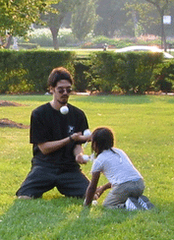
And it’s juggling in parks in NY and meeting kids and seeing the joy and wonder on their faces. Because magic, real magic, exists all around us, and while traveling isn’t necessary to find it, it sometimes reminds us, reminds me to keep looking, to keep seeing the world anew.
One of my favorite Japanese artists, Yoshihiro Suda, would finely sculpt every day plants and weeds, and place them in hard to find locations in museums. Discovering art – which was often merely a finely crafted depiction of the common (and sometimes common nuisances) – would become a magical experience, an experience we could replicate if only we could peel back the scales on our eyes. Then we can find the romantic poetry in order and the every day, like Gabriel Syme in G.K. Chesterton’s theological masterpiece, The Man Who Was Thursday. Or as Alan Moore commented in The Watchmen:
“But the world is so full of people, so crowded with these miracles that they become commonplace and we forget... I forget. We gaze continually at the world and it grows dull in our perceptions. Yet seen from the another's vantage point, as if new, it may still take our breath away. Come... dry your eyes, for you are life, rarer than a quark and unpredictable beyond the dreams of Heisenberg. Come, dry your eyes. And let's go home.”
Wednesday, February 25, 2009
fear and trembling
fear and trembling.
Tiny frail girls, barely past puberty, trembling half naked on the stage – terror etched into their eyes as they cower before their pimps and mistresses, forced to flout their youth and beauty to the voracious appetite of Western and local sex tourists.
Welcome to Patpong, Bangkok. Welcome to hell.
I think of the movie, Pan’s Labyrinth. The monster feasting on children with a banquet table before it. Why is there such a longing among many to destroy innocence, to devour beauty? Is that not part of the appeal, the Western fetish with wide-eyed Asian women, looking years younger than their age? There were plenty of places to get cheap sex with pretty Asian women, but the more youthful, the more innocent the better, the stronger the draw.
I’m in Phnom Penh. The weekend night market is in full swing. A romantic song floats through the air, and a tiny girl, probably less than 10 years old, takes the stage in scarlet lipstick and make-up, a bikini-style red dress barely covering her un-developed breasts. A shirtless man takes the stage and joins her in song. Romance fills the air.
Most sex tourism, most child rapists in Southeast Asia aren’t Westerners. They’re locals. And it’s easy to see how in the culture. Westerners flee to Southeast Asia to find a haven for their appetites of young, under-aged Asian flesh. Local males can feast upon it at will. It’s part of the culture; it’s common and normal. The night belongs to them.
Here, I’m the freak and outlier.
I think of the Madonna-Whore syndrome. That attraction to the Madonna figure of Virgin Mary, and that lust for the whore and slut. You walk around the bars and clubs of cities of Southeast Asia enough, and you see both blended together – the sweet innocent faces of Cambodian and Thai girls, wrapped in sexy clothing and erotic dances.
I think of myself. Being a white male, you often get attention from the girls. They’d wave, or say hi flirtatiously, or run over to exchange a few words and run back giggling to their girlfriends. The playful flirting is fun. The attention is nice. They’re mostly schoolgirls, probably barely out of highschool.
When does friendliness end and pedophilia begin? When do we cross the line and begin to become the monster we hate? Like Nietzsche wrote, “You gaze into the abyss and the abyss gazes into you. Stare not at monsters, lest ye become a monster.”
Among the backpacker and traveler circles, we rightly voice self-righteous indignation at sex tourism. But most of us are sex tourists as well. We don’t go to rape children, or buy Thai and Cambodian “love” for a night of passionate fucking, but we go as silent witnesses, silent voyeurs into a world of rape and exploitation and brutality. And then we return to our bars and our guesthouses, and voice our indignation to each other, patting ourselves on the back for being better than the sex tourists. But many of us go to see the culture of exploitation; it is a twisted, perverted tourist attraction, another cultural experience to photograph and pocket in our bag of experiences, and move on to the next one. And we become sex tourists as well.
I’m in a bar now. It’s an unlikely place to find myself. Cambodian girls dance around poles and on tables in sexy outfits; girls talk and flirt with you to get you to buy them drinks, which they earn a commission for. A mid-aged American sits down across from me. He tells me about his wife working in Burma for MSF, all the while he wraps his arm around a young Cambodian beauty next to him and slides his hand over her legs. I meet a nice pretty girl. She doesn’t seem to belong here. I suppose she doesn’t belong here. None of them do. People shouldn’t have to sell themselves. People shouldn’t be for sale as objects, even if they consent to it. Anymore than anyone should be willing to buy someone like an accessory at a market. What corrupting, corroding effect does that have on our soul?
I look around and I see people that treat women as nothing more than meat and objects to be exploited and used. I look around and see young girls trapped in a prison of sorts, wanting to study and have careers but forced to sell themselves in order to survive and support their families. I look around and see men eating it up, devouring youth and real beauty.
I look around and I see my enemy. And it is myself.
I left in the morning. Paid for my drinks. My entrance fee. My contribution to a culture of selling youth and beauty to the eager appetites of elderly and young men. They offer love, marriage to some of the women. Seeing love as another commodity to be bought. Offering another form of prostitution decorated in the veneer of respectability.
I started this trip reading Thomas Merton’s classic work, Seven Storey Mountain. Similar to Saint Augustine’s confessions, it’s a story of being lost and finding one’s way through the fog, a story of intellectual and physical debauchery before returning to a simpler, more spiritual path.
I haven’t crossed any line that most would find wrong. But me.
I went for a night to witness and experience. I forgot that my silence has a voice, and a price.
Sunday, February 22, 2009
expected value
There’s no guarantee the money you give to charity will help. Sometimes it may hurt. But in general, and especially regarding the best organizations like MSF, Oxfam, UNICEF, etc, charity is at worst ineffective. It’s at worst a waste of money. But we gamble on things all the time. We gamble on a movie we haven’t seen, betting that we’ll enjoy it. Or going to a restaurant we’ve never been to, or try a dish we’ve never had. Gambling is simply part of life.
With something as complicated as development, you can’t expect a guarantee that it’ll help a child go to school, or give a sexually abused girl psychological counseling, or save someone’s life. The question is not whether charity will definitely help. The question is whether you’re willing to take the gamble that it might.
When I give money, or when I work for an organization like UNICEF, it’s not because I know it will help. There may be only a 10 or 20 percent chance that I will do any good, but when we’re talking about saving a life, or giving a child an opportunity to have a future, that’s a gamble I’m willing to take.
I was also thinking about this recently because it relates to life in general. Most of our decisions are gambles. The trips we take, the hotels we stay at, the bars we go to. We obviously have ways of calculating the odds, but in the end, it’s a roll of the dice. In probability, they talk about the “expected value”, where you calculate the risks and potential reward or loss, and then get the expected value of any endeavor.
A few of you will know what I’m talking about, but I suppose I decided the odds are low anything will happen or work out with the path I’ve set myself on. But even so, if it does, the rewards, the benefit could be so great that the expected value is still high, and the gamble is the right one.
Monday, February 9, 2009
S-21 (Cambodia)
Many things strike you about the museum. It’s old. Run-down. Many of the torture chambers left as they were, the instruments lying on the metal beds, a single large photo of the victim on the beige wall. You can walk through the tiny cells, some separated by wood, some by brick, the balconies covered in barbed wall to prevent desperate prisons from jumping to their deaths, euthanizing themselves against more torture. You walk through endless rows of pictures of the prisoners – men, women, young, and old. Young girls and boys stare at you with blank eyes, sometimes a tinge of anguish peaks through, or you see a slight grimace in the otherwise set stares. Women with babies in their arms face you in black and white. The faces seem to stretch on forever. You want to move quickly through them, spare yourself the silent torture of their penetrating gaze. But you can’t. Or I can’t. I looked at every face. Everyone who had a story, a family, a life. What right did I have to turn away. In Guatemala, victims walked weeks just to go to some run-down commissioner in a tent to tell their story to the truth commission. The desire to tell stories, to explain what happened, to be have your sufferings heard and recognized, it burns deeply within us all. What right did I have to not listen to what they had to say. After all they went through, didn’t their silence at least have the right to be heard.
The rows of pictures continue, and begin to transform to scenes of torture. You recognize faces of inmates you saw earlier, now twisted and distorted in anguish and horror. Children tortured to death in the burst of revolutionary fervor, in a desire for an agrarian utopia. It’s often overlooked that genocide is a utopian ideology; it’s idealistic in the purest sense. Genocidiares have a vision of an ideal world, and set about establishing it, with blood and fire.
I think of the pretty Cambodian girl I hung out with last night. I see her face among the rows of black and white photos. Her in the cramped prison cells.
I flip through the notes from previous visitors. Never again. Nunca mas. Never forget. Words of outrage.
And Darfur still burns.
Sunday, February 8, 2009
Battambang (Cambodia)
In Battambang, I took a bike around to explore the main temples and sites. It turned out to be a magical day. At one of the temples (which actually served as the inspiration for Angkor Wat), I met some kids on a school trip to the temple, and ended up chatting with them in bits of Cambodian (Khmer) and English. They offered me some food (slices of mango and oranges), and then told me about a cave around the base of the hill that they were going to. I followed them down the steep path to cave entrance, where two young kids in tattered clothes and flashlights were waiting. Over the next half hour to an hour, they led us through the cave, crouching and crawling through tight spaces, which opened up into large caverns with sunlight piercing the roof hundreds of feet above us. The final stopping point was a small Buddha shrine in one of the caverns, surrounded by dripping stalagtites.
Similar to Burma, Battambang receives few tourists, and probably as a result, the people are especially warm and welcoming. “hellos” and “bye-byes” greet you at every turn, and girls giggle and wave at the sight of a white man wandering through the countryside. My little bit of Cambodian (Khmer) makes their response especially enjoyable, as they respond with surprise and delight, or run away giggling after exchanging a few words. At lunch, I juggled for some young school kids, and they shyly hide from me anytime I tried to take a picture (at the request of their mother). I have some great shots of them burying their faces in their arms.
In evening though Battambang really comes alive. The main riverside garden or park is packed with food vendors and Cambodians dancing. Similar to one park in Bangkok, the dance is a combination of yoga, aerobics, and choreographed moves. The scene was picture perfect though. The sun setting over the river, a park packed with Cambodians dancing to variety of songs including some oldies and Beatles hits, and children playing all around you. As I said, magical.
Sitting in the park, watching the various dances and children around me, I thought about another thing I had seen today, one of the killing caves of Battambang, where the Khmer Rouge bayoneted, bludgeoned and shot to death thousands of people, dumping them deep in the cavernous mouth of the earth. The killing cave is now mostly a series of concrete steps down into the cavern, where you find a platform with a reclining Buddha, peacefully smiling at you, and various shrines and cages filled with skulls and bones –all mixed together, a jumbled mess as identity was lost and forgotten in the mass grave. My driver for the day told me about the people in his family who were killed by the Khmer Rouge, and how they still don’t know where their bodies lie. Perhaps in that gash in the earth, mixed among the bones, lie members of his family.
More steps led me further into the darkness, deeper in the earth’s mouth. It was almost pitch black except for a stream of light from the surface, piercing the darkness. I wonder how many people stared up from this point, in their final moments. How many died here.
I’m proud of being an American. But in Cambodia, staring out from the grave in the belly of the earth, today is not a proud day. America failed the Cambodians. America betrayed them. And America bears a terrible responsibility for the brutal bombing inflicted on the country, for its abandonment of Cambodia to the Khmer Rouge, and for providing political support to the Khmer Rouge after Vietnam invaded in 1979 and stopped the genocide.
Today was a magical day. But not all magic is good or heartwarming. Seeing the Cambodians now, feeling their warmth and hospitality, watching them dance to Beatles songs as the sun lights up the sky, I can still feel the dampness of the killing cave. Its magic will also stay with me.
Cambodia
After a day of this, I decided to try to and see if I could get some kids to loosen up, and interact with them as kids rather than just a hassle to be ignored. That morning I biked the 15 kms out to Roulos group. The normal swarm of kids converged on me before I made it to the temple entrance, and then converged again after I left. I bought a soda (to recover from the long, hot bike ride), and then went searching for rocks. Recruiting the kids into my quest, and I preceded to juggle with rocks, entertaining the kids for awhile. The kids quickly warmed to after this, and even prepared some gifts for me out of flowers, and would continually bring me more rocks whenever I dropped (which given the various shapes of the rocks, was quite often...)
The next day, continuing my experiment, I met some Cambodian girls at lunch, and after joking around with them for awhile, talking about their lives, etc, I introduced them to the metal band Volbeat on my ipod and tried semi-successfully to get them to dance with me (meaning two of them sorta did, but the other two didn't). Still all in all it was quite a successful day. Oh, and of course, on the way, I saw some amazing temples like Ta Phom and Angkor Thom and Bayon, etc :)
Side note, the night I juggled with the kids at the Roulos Group, I also met a cool Canadian, who happened to be a magician, so we spent the night with me teaching and showing juggling tricks and him weaving his crazy card magic. Quite a night. Siem Reap is taken over by the western circus.
Golden Rock (Burma)
It hard to overstate how friendly, warm, and charming the people of Burma are. Yesterday Taylor (an American that I’m traveling with) and I went to speak at an English class and just talk with students for a couple hours. Afterwards, we made our way over to the Golden Rock, which is near a town called Kyaiktiyo. After arriving in Kyaiktiyo, you take a pickup truck to the base camp, Kinpun, for trips the Golden Rock. The Golden Rock a precarious boulder, just balancing off the edge of a cliff. Supposedly it rests there on a Buddha hair (holding the boulder in place) and on top of the boulder is a large golden stupa. Anyway, the base camp Kinpun is quite an interesting town. All along the main street are souvenir vendors, and the main souvenirs seemed to, I kid you not, large bamboo machine guns with a little wind to make the sound of a gun shooting. Along the side of most of these guns is written, in big letters, “U.S.A.”
For a military state, which has quite a bit of animosity towards USA, these USA labeled guns at one of the most sacred sites in all of Burma was quite interesting in itself. That the kids would run around pretending to be Rambo (and specifically Rambo 4 according to them), whose latest movie is banned for featuring, among other things, Rambo massacring the army of Burma’s junta, only added to the bizarre act of playfulness and political defiance. The arrival of two American’s, Taylor and myself, I think added to the fun as we played with kids, pretending to be shot and shoot eachother.
At the store, I bought a bamboo bracelet for 300 kyats, or approximately 25-30 cents.
The store owner and presumably their father gave Taylor and me each a nice necklace as a present. Each necklace probably worth more than the bracelet. Which is both remarkably generous and a remarkably bad business model.
We walked around some more. I’ve never been such a tourist attraction before. Girls will point and giggle, come over and pinch you and then walk or run away. People come out to the streets, almost lining the walkways like adoring fans, just to wave and say hi as you pass by. Child stare and then wave and smile when you mumble a few Burmese words or simply wave.
Today we hiked up to the Golden Rock. Most tourists take a pick-up truck most of the way, only hiking the last 45 minutes, so for most of the way up, foreign tourists weren’t a rare sight, they were non-existent. But along the way, we passed many pilgrims from Burma making the return trip, toting their large bamboo USA guns on their shoulders. Our greeting on “min-gala-beh” received a wide range of responses to “oooooh! Mingalabeh!” to boys waving their hands and pumping fists, “Mingalabeh!”, to Burmese women telling us we were beautiful, to girls giggling and pointing. The greetings of “bye-bye” instead of “hello” were also endearing. Near the top of the ridge, we can caught beautiful views on either side and found a small place where I bought a squirrel (roasted to a crisp) and ate it (while Taylor took a few weary bites). The squirrel looked thoroughly disgusting, though it just tasted like well-cooked turkey jerky. The owners of the shop amused themselves by bringing out various things to shock us like a large stuffed muskrat and other heads of dead animals. After that short stop, we continued up and reached the temple complex for the Golden Rock (paying the exorbitant foreigners entrance fee, oddly always charged in US dollars. Sometimes they’d let you pay in kyat, but you pay not in the government rate, which is 400 kyats to the dollar, but the black market rate, which is 1200 kyats to the dollar… so the government doesn’t even follow its own rules on the exchange rate, after all they want to pump us for as much cash as possible).
After watching the sunset at the Golden Rock, we headed back down the mountain, catching the last pickup truck to Kinpun camp. Taylor and I decided to celebrate the day with an ice cream shop we managed to find after much searching. But ice cream is well worth the quest.